Quality assessment of spectroscopic data reduction pipelines using ML
We are implementing and scaling a UMAP + FoF framework, following Suárez-Pérez (2023), to identify anomalous DESI spectra and prioritize expert review at survey scale.
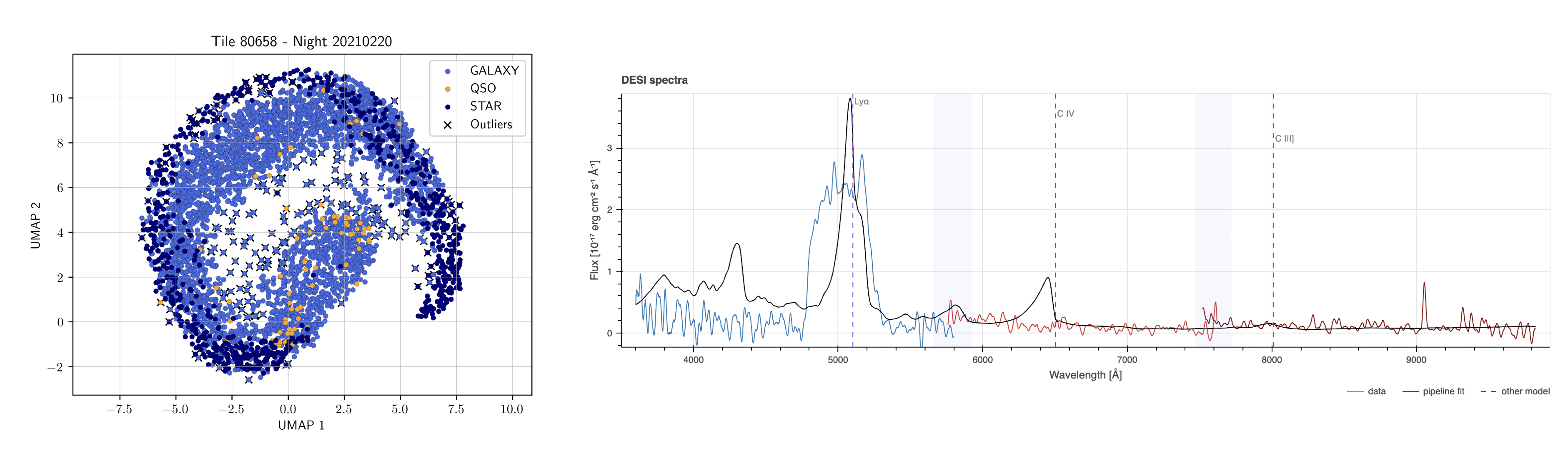
UMAP (cosine, 2D) FoF groups Per-tile processing Inspector-ready IDs Cross-match: HSC/KiDS
What we have found
- Distribution of candidates across tiles: a minority of fields dominate the counts.
- Instrumental patterns: elevated rates near spectrograph/petal boundaries (e.g., FIBERID banding).
- Recurrent morphologies: negative blue-arm continuum, arm-join flux steps, and arm-dependent template mismatches.
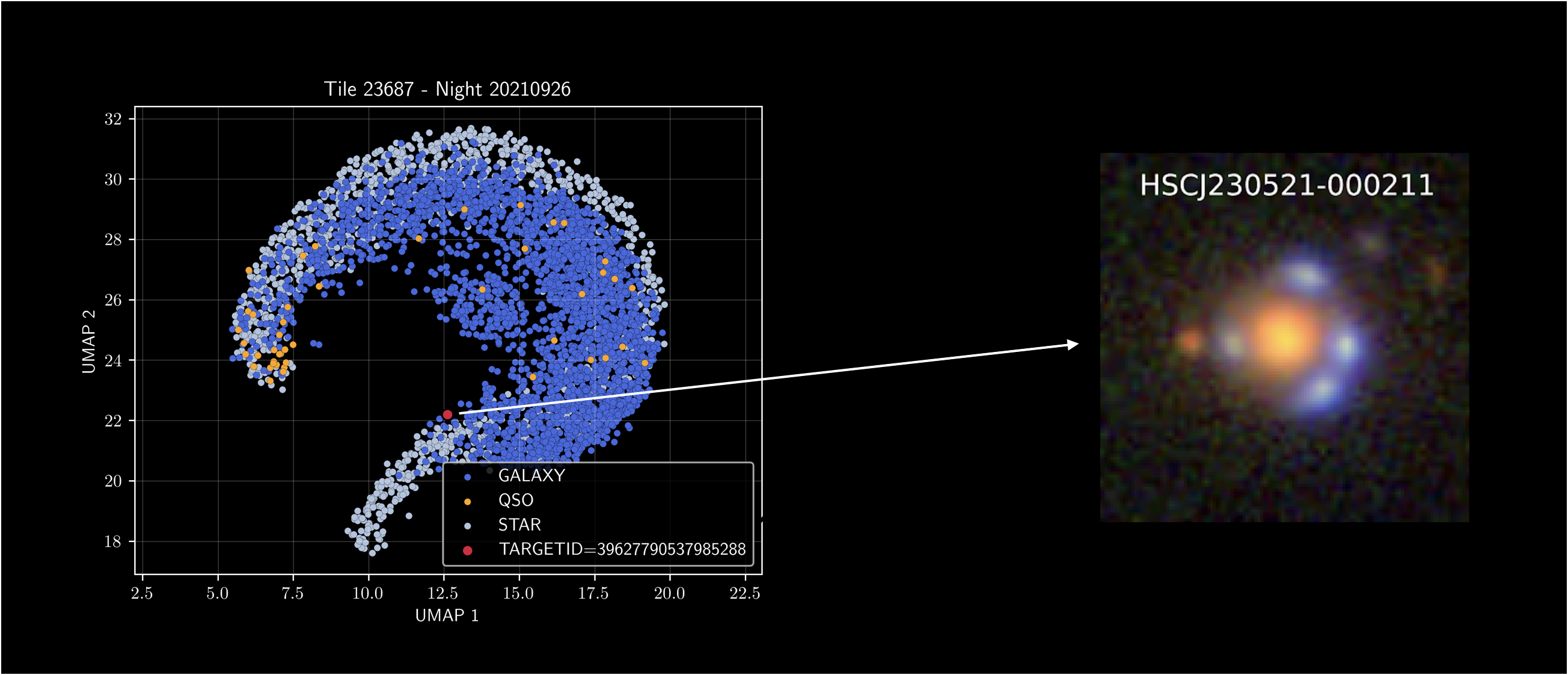
- Astrophysical outliers: cross-matching flagged objects reveals confirmed gravitational lenses present in external catalogs (e.g., HSC, KiDS).
Why it matters
The pipeline highlights the small fraction of spectra that most warrant expert inspection, delivers stable,
class-stratified QA metrics, and localizes issues to specific tiles, petals, and fibers, making it practical to monitor
reduction performance consistently across data releases.
At the same time, catalog cross-matching naturally brings
forward astrophysically interesting systems, such as known gravitational lenses.
Several flagged spectra coincide with known lenses, validating the approach on real survey data.
Collaborators
- Jaime E. Forero-Romero Co-author — Universidad de los Andes (Bogotá, Colombia)
- John F. Suárez-Pérez Co-author — Tecnológico de Monterrey (Zapopan, México)
- Stephen Bailey Co-author — Lawrence Berkeley National Laboratory / DESI Collaboration
- Anthony Kremin Co-author — Lawrence Berkeley National Laboratory / DESI Collaboration
- DESI Collaboration Community and tooling support
Resources
Draft results are summarized here from ongoing paper: “Quality assessment of spectroscopic data reduction pipelines using AI: scrutinizing DESI DR2.”