Estimating Radio-Antenna Orientation from Galactic Noise
This project studies how the daily modulation of Galactic radio noise can be used to estimate the absolute azimuth of antennas in the IceCube Surface Array at the South Pole. By tracking sidereal variations in the background RMS, the analysis provides a scalable way to recover antenna orientation and complements traditional in-situ survey methods.
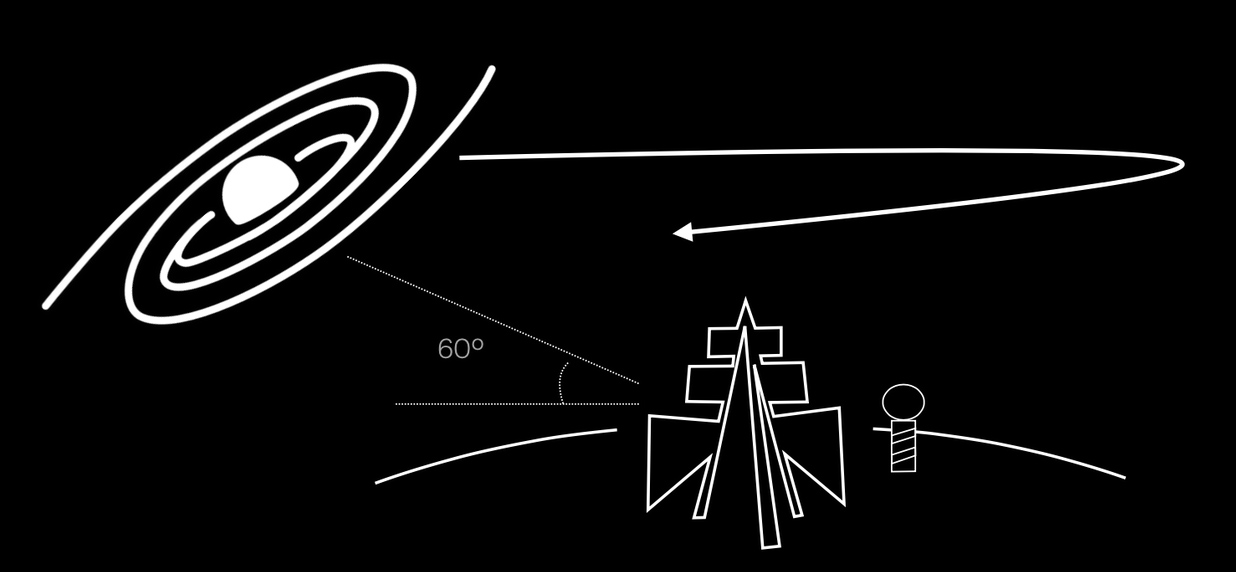
RMS from pulse stream Daily centering Outlier and spike filtering Sinusoidal least-squares fit Cross-check with in-situ surveys
Why it matters
The Galactic radio background provides a stable astrophysical reference that varies with sidereal time. This makes it possible to use the sky itself as a calibration source for antenna alignment, reducing dependence on costly field campaigns and enabling orientation checks at scale across the array.
Methodology
The workflow uses background RMS measurements in a frequency range where Galactic emission dominates, applies cleaning and filtering steps to suppress transient contamination, and fits a sinusoidal model to recover the phase corresponding to the antenna’s preferred orientation.
- Band selection: track RMS in the 100–150 MHz range where Galactic noise dominates the baseline.
- Cleaning: remove spikes and outliers, and center the RMS daily to suppress seasonal drifts and hardware steps.
- Sidereal modeling: fit a sinusoid as a function of Galactic azimuth to recover the angle of maximum response.
- Orientation estimate: convert the fitted phase into an absolute azimuth offset for each antenna and polarization.
What this project produces
- Per-antenna orientation estimates: derived from the sidereal modulation of Galactic noise.
- Cleaned RMS time series: suitable for long-baseline calibration studies.
- Cross-checks against survey measurements: to validate the radio-based method.
- Scalable calibration workflow: applicable across multiple stations without on-site campaigns.
Resources
This work was presented at the International Cosmic Ray Conference (ICRC 2025) and is now available as published conference proceedings.
Collaborators
- Paras Koundal Department of Physics & Astronomy, University of Delaware
- Frank G. Schröder Department of Physics & Astronomy, University of Delaware
- IceCube Collaboration Scientific collaboration and experimental context