Galaxy Stellar Mass Estimation with Graph Neural Networks
This project explores stellar-mass estimation for galaxies in the DESI Early Data Release Bright Galaxy Survey (EDR/BGS) using machine-learning models built from photometric measurements and spectroscopic redshifts. The main goal is to compare simple and interpretable regressors with an initial Graph Neural Network (GNN) framework that incorporates spatial relationships between galaxies through graph-based representations.
DESI EDR / BGS PROVABGS stellar masses Fluxes: g r z W1 W2 Spectroscopic redshift Graph from spatial proximity PyTorch Geometric
Why it matters
Stellar mass is one of the central quantities for understanding galaxy evolution, since it is closely related to star-formation history, quenching, morphology, and the interpretation of population-level trends. For large spectroscopic surveys such as DESI, efficient methods to estimate stellar mass are especially useful, since traditional SED-based approaches can be computationally expensive when applied at scale.
Methodology
The analysis starts from DESI BGS galaxies with associated stellar-mass estimates from PROVABGS. Input features include broadband flux measurements in the g, r, z, W1, and W2 bands, together with redshift. In the graph-based version, galaxies are represented as nodes and connected according to spatial proximity, allowing the model to propagate information through local neighborhoods.
- Input features: optical and infrared fluxes plus spectroscopic redshift.
- Reference labels: stellar-mass estimates matched to PROVABGS entries.
- Tabular baselines: multiple linear regression and Random Forest regression trained on the same observational features.
- Graph construction: galaxies are treated as nodes, with edges defined from spatial separations below a fixed distance threshold.
- GNN model: an initial graph-convolution architecture implemented with message passing and batch normalization.
What this project shows
- Strong baseline performance: simple regression models already recover stellar masses very accurately from DESI BGS observables.
- Linear structure in the data: redshift appears as one of the most strongly correlated predictors of stellar mass.
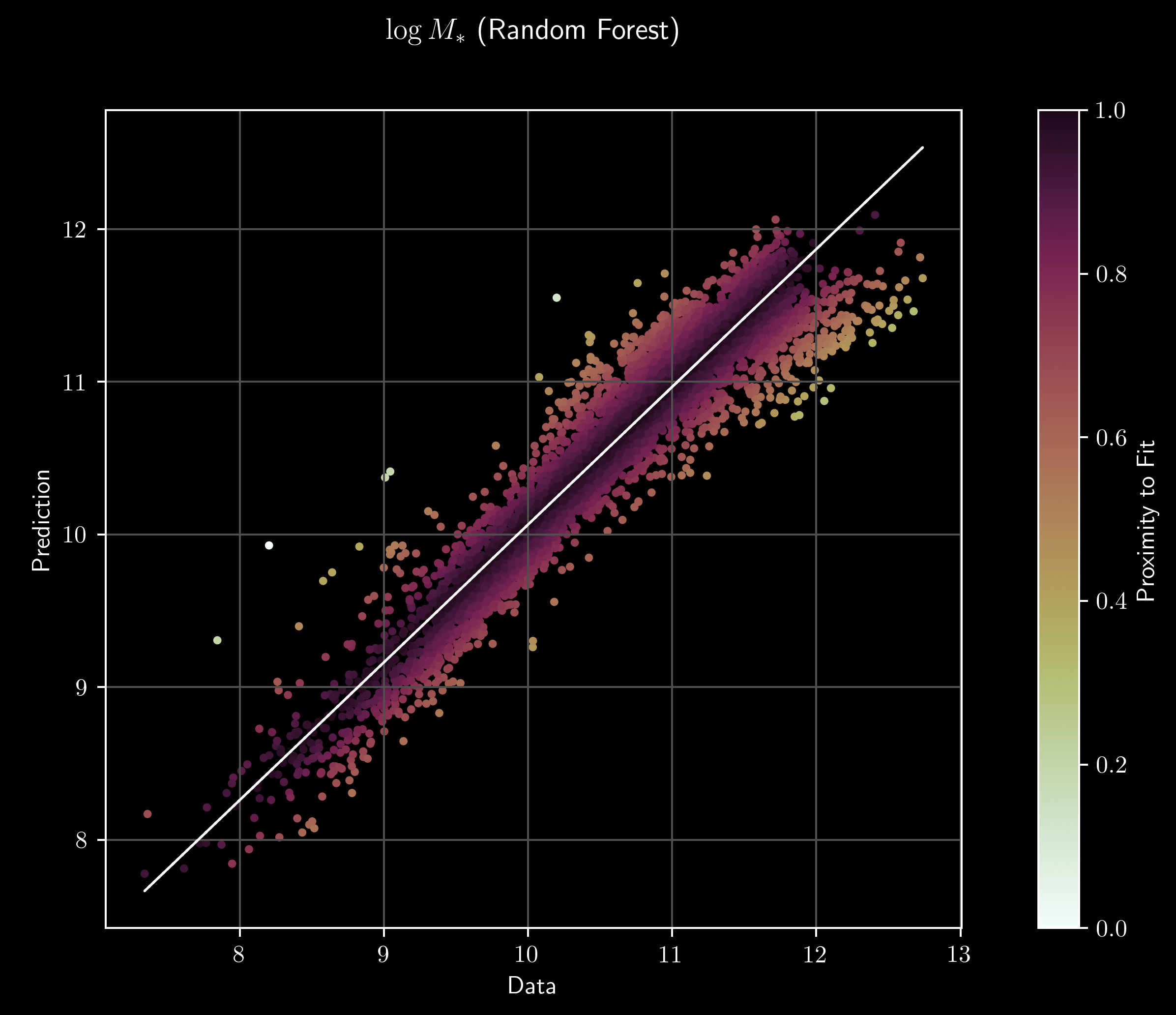
- Robust nonlinear baseline: Random Forest captures more complex feature interactions while remaining stable against irrelevant inputs.
- Exploratory graph approach: the initial GNN establishes a graph-based framework for future improvements using observational galaxy relations.
Model comparison
- Multiple linear regression: the strongest results in the current study, with very high predictive accuracy across training and held-out rosettes.
- Random Forest: also performs well, with test values around R² ≈ 0.90 and low MSE in the rosettes shown.
- Initial GNN: in its first implementation, the graph model shows more modest performance and is best interpreted as a proof of concept rather than the final best-performing method.
Resources
This project combines observational DESI data, simple interpretable regressors, and an initial graph-neural-network implementation to study fast stellar-mass estimation in bright galaxies.
Collaborators
- Jaime E. Forero-Romero Universidad de los Andes (Bogotá, Colombia)